I read Red Hat’s article What is CI/CD? with a highlighter in hand. These are the ideas I kept, in my own words.
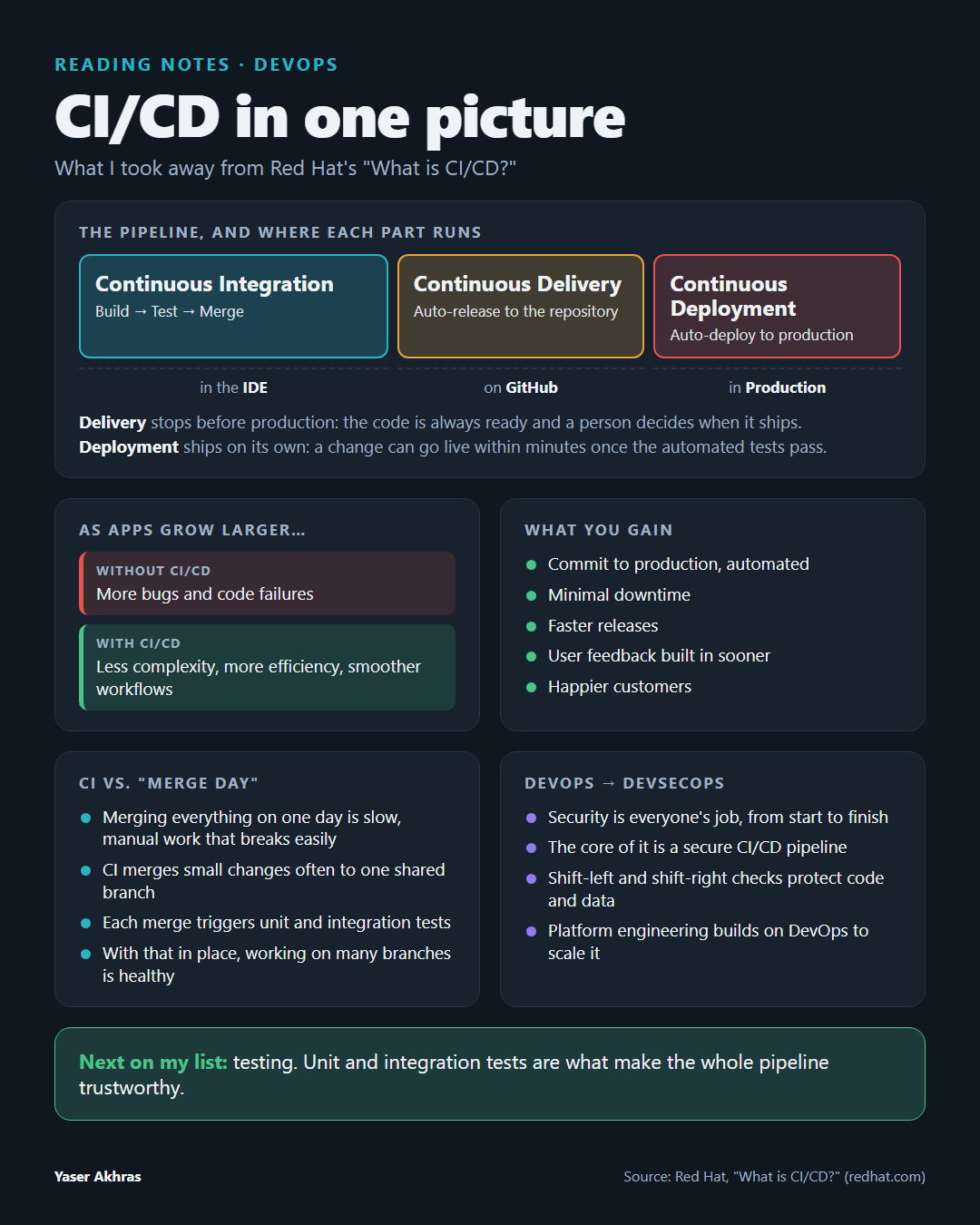
The pipeline: three stages, three places
The way I picture it, each stage runs somewhere different:
| Stage | What happens | Where |
|---|---|---|
| Continuous Integration | Build → Test → Merge | in the IDE |
| Continuous Delivery | Validated code is released to the repository automatically | on GitHub |
| Continuous Deployment | Released code goes to production automatically | in Production |
Red Hat calls these connected practices the CI/CD pipeline.
Why it matters
As apps grow larger, working without CI/CD means more bugs and code failures. CI/CD helps to “decrease complexity, increase efficiency, and streamline workflows”. In practice that means:
- code goes from commit to production automatically,
- downtime is kept to a minimum,
- releases happen faster,
- user feedback gets built in sooner and more often,
- and in the end, customers are happier.
CI vs. “merge day”
Without CI, teams often merge every branch together on a single “merge day”, which is slow, manual work that breaks easily. CI replaces that with frequent merges to one shared branch. Every merge triggers automated tests, usually unit and integration tests, to make sure nothing broke.
My takeaway: with CI in place, working on many branches is healthy, not a risk.
The two CDs: delivery vs. deployment
- Continuous delivery keeps the codebase always ready to deploy. A person still decides when it goes to production.
- Continuous deployment removes that manual gate. A change “could go live within minutes of writing it (assuming it passes automated testing).”
So deployment is only as safe as your test automation.
From DevOps to DevSecOps
DevOps and CI/CD share one goal: getting an idea from development into production faster. DevSecOps adds that security is a shared responsibility from start to finish, and its core is a secure CI/CD pipeline. Shift-left and shift-right security checks help protect code, prevent data leaks and keep you compliant. Platform engineering builds on DevOps to scale all of this across teams.
What’s next for me
Every stage above depends on good tests. My note in the margin says it plainly: “We need to learn more about Test.” Unit and integration testing is my next topic.
Source: Red Hat, “What is CI/CD?”, updated June 10, 2025. Quotes are short excerpts; the rest is my summary.